De Vino Vero
The Story
Like all stories, this started with a woman. Okay, actually that's not true as what this was another case of necessity being the mother of invention.
You see, I have understood for a long time that there are no true wine experts, though there are people with more knowledge than others. Wine is too voluminous a topic for a person to know and understand everything, in fact, wine knowledge is a combination of rote memory and knowledge through experience. The experience part is biased by how much one actually knows through having done things, like grown grapes and actually made wine, with more coming from one's experience with a certain set of vines and making a certain set of wines. Growing regions differ, the years differ and the amount of time needed to learn how to make a good wine in one region does not necessarily translate into making another type of wine in the same region or even somewhere else. As for the concept of rote memory, this is fraught with a lot of errors as you are essentially trusting the information provided by others, and time and time again we find out that some of that information is always incorrect.
I still laugh at all of the things that people who serve or sell wine get wrong, and I also look back at my past mispronunciation of wine names and how in some cases my knowledge of certain things were outdated, like when I didn't know that the rules for Amarone had changed at least ten years ago.
Given this understanding, it begs to say that if people within the wine industry can be actually not very knowledgeable and indeed wrong, then how is the customer going to ever really know what they are buying? And then when you add in the lies and the deceits, it just makes it worse.
The invention of this was fueled by my desire to not purchase one more bottle of stale wine, as well as me having the ability to locate other wines that I would tend to like. This is not based on a taste profile, but actually understanding that there are certain grapes that I like more and certain ones that I don't, as well as liking wines that come from certain terroirs or made in certain styles. I like my Amarones to contain Oseleta; I love my Pinot Grigios to come from the clean mountain regions of Alto Adige, Trentino and the Suditrol where the grapes are harvested by hand; I prefer the traditional method over the Charmat method when dealing with Pinot Noir and Chardonnay. I do not like an oaked or overoaked Chardonnay; I do not like a stringent and watery Primitivo or Pinot Noir; I do not like a wine named after a region and not know exactly what grapes are in it.
And besides the aforementioned problems, depending upon where you live, the whole business of wine has become so saturated with people who merely want to perpetuate the myth that they are more cultured or socially elevated that it really damages the wine industry. Some of these people actually run away people who would be more willing to make wine a part of their lives, and others tend to stunt the experiences of others by constantly [and only] throwing them mass-produced swill which falls into the category of whatever is supposed to be hot (Argentinian Malbec, Australian Shiraz, South African Pinotage) or falls into a very limited number of varietals (Chardonnay, Sauvignon Blanc, Pinot Grigio, Cabernet Sauvignon, Merlot, Pinot Noir, Syrah). Instead of pushing good wines and exposing customers to new things, some players in the game are merely trying to capitalize and sell variations of what the most novice consumer is willing to fork over money for (Moscato, sweet reds and other things that taste like candy but don't pair with most foods).
The truth is that people are inquisitive and if you give them the easier ability to get the information without them having to spend several years trying to learn all of the sub-appellations in France, you can turn them into lifelong consumers and open up business for myriad producers. People also are more interested in not only trying new things, but having things that others haven't experienced yet. With the amount of producers in the world, combined with the total number of wines offered, this means that there is a lot of potential.
But to affect this, the producer has to be empowered in such a way where no one else can say anything else about their wines which aren't true. As a writer, a poet, and an artist, I understand this so much as having people try to sell my wares or tell someone what a certain book, poem or picture is about, and be completely wrong.
This is where this system comes in and why I built it.
Over the past twenty years, I have built a number of systems for various industries as well as have fixed and expanded pre-existing systems. I have probably been reading and studying various industries and fields since 1992 when my monthly reading included magazines such as Inc., Entrepreneur, and Success and expanded to titles like Wired, Fast Company and Business 2.0 -- I actually called up Fred Franzia on a Saturday after reading an article on him and we talked for about fifty minutes; this is of course in addition to magazines regarding programming, creative writing, film and video, health and fitness and history. I've been able to spot problems in logic and practice – you'd be surprised by how much of that exists in large corporations, especially multi-national ones – and even ripped this system apart and rebuilt it to be more granular in what it could do in regards to the level of information presented; this also involved adding in the industry of extra virgin olive oil which we know is full of fraudulent goods.
For those that have met me, they know that outside of my gregarious attitude and humor, that I have a passion for wine and people [and Grappa]. I study, I read, and I am open to learning new things, experiencing new wines, and meeting new people. While this could turn into something very lucrative, what's more important to me is the system working for both producer and consumer. I'd rather see someone's wine fly off the shelf versus sit there for years while it becomes negatively affected by light and heat. I want to see people finding brands that have character and individuality, trying and hopefully enjoying them, rather than getting the same old, same old, day in and out. Hell, I want to be like the blood relative that comes in and helps out his family business, or just the guy that becomes like a family member in the process.
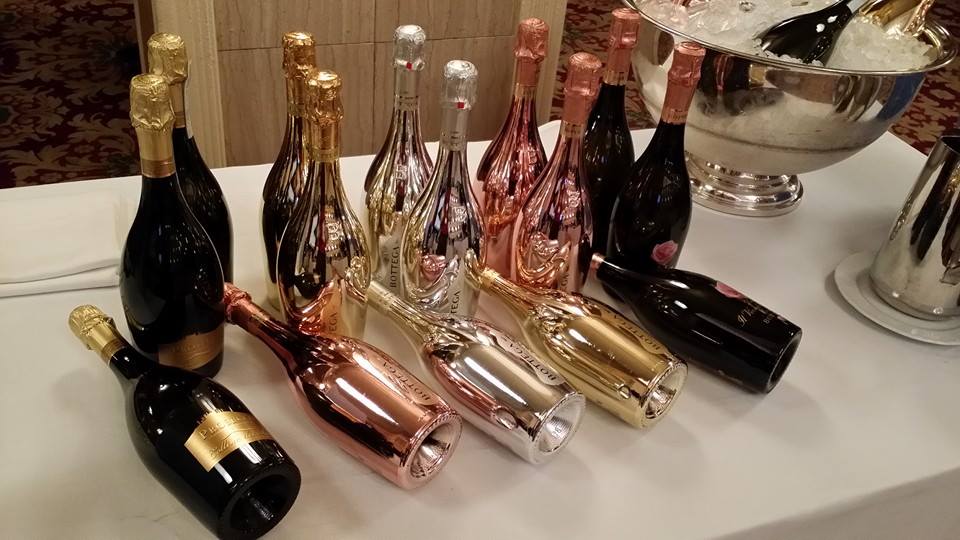
My resolve on doing this is because I see this as revolutionizing the wine industry, an industry which in some ways is painting itself into the corner. Producers in Europe get the impression that the American market is such a juggernaut of an opportunity. It's like how Charlie imagined the fashion show in Milan to be the center of everything in the movie Kinky Boots, having never himself been there. I lament for the producer anytime that I see a bottle of wine that has lost its magic that has a note next to it talking about how great it is and that the price has been discounted ( see pics). I have hated the fact that I know a producer like Donnafugata has a bevy of great wines, but the only ones I see are the ones which are costly and not the ones that I want to drink weekly; they can tell you that I have complained about it for the last three years while attending VinItaly. And I am sick of importers trying to tell you how rare something is, when in fact a ton of it is made.
What pushes me on are the struggles of people like Tesla (alternating current won out) and Chester Carlson (xerography). While you might not know the story of the latter, here it is: Chester was a law student who found the absurdity in trying to mimeograph copies of things or paying a typist to reproduce a page manually. He studied science and came up with a way to use an electrostatic charge and a glass plate to copy an image in one place and reproduce it. And then he went to market it to the biggest government agencies and companies of his day. And he was turned down 59 times. But it was the 60th which was the charm, and his invention revolutionized business three-fold. The copier, the scanner and the fax machine all are because of him. He changed the world, but he got turned down by those that later on relied on his invention because they couldn't see the usefulness of it. This system is no exception.
With all that said, this whole thing is not about me, but about the producers and the consumers, because that's exactly who it's for. To get this done, it will takes all sorts of partnerships and alliances, which I look forward to embarking upon.
This is just the start of something, for which I have already figured out the second and third phases. Trust me and I'll give you a better chance to shine.
Are you interested in learning more? Feel free. Get in Touch